∑math20

Number theory · Result 011

Prime-factor statistics of \(p-1\)

3 papers

Proves that the normalized ordered logarithms of the prime factors of \(p-1\), counted with multiplicity, converge jointly to the Poisson–Dirichlet law \(\mathrm{PD}(1)\) as p ranges uniformly over primes up to x and \(x\to\infty\). This resolves the Ford–Konyagin–Luca conjecture. It also proves that infinitely many integers n have more than \(n^{1-\varepsilon}\) totient preimages, for every ε > 0.

Watch

▶Introduction: the problem and why it mattersin preparation
▶The presented solutionin preparation

Papers 3

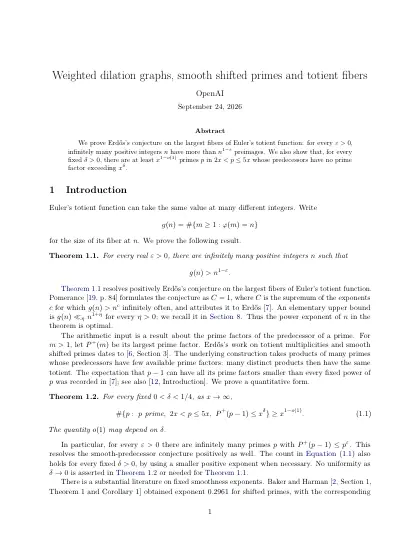
First page of Weighted dilation graphs, smooth shifted primes and totient fibers

Weighted dilation graphs, smooth shifted primes and totient fibers

OpenAI · September 24, 2026

We prove Erdős's conjecture on the largest fibers of Euler's totient function: for every ε > 0, infinitely many positive integers n have more than \(n^{1-\varepsilon }\) preimages. We also show that, for every fixed δ > 0, there are at least \(x^{1-o(1)}\) primes p in \(2x\lt p\le5x\) whose predecessors have no prime factor exceeding xδ.

Read PDF Download Source

Cite
@misc{OAI:Weighted-Dilation-Graphs-Smooth-Shifted-Primes-and-Totient-Fibers-September-24-2026,
  author = {{OpenAI}},
  title = {{Weighted dilation graphs, smooth shifted primes and totient fibers}},
  howpublished = {OpenAI Math Release preprint
                  \href{https://github.com/openai/math/blob/main/preprints/Weighted-Dilation-Graphs-Smooth-Shifted-Primes-and-Totient-Fibers-September-24-2026/paper.pdf}{OAI:Weighted-Dilation-Graphs-Smooth-Shifted-Primes-and-Totient-Fibers-September-24-2026}},
  year = {2026}
}
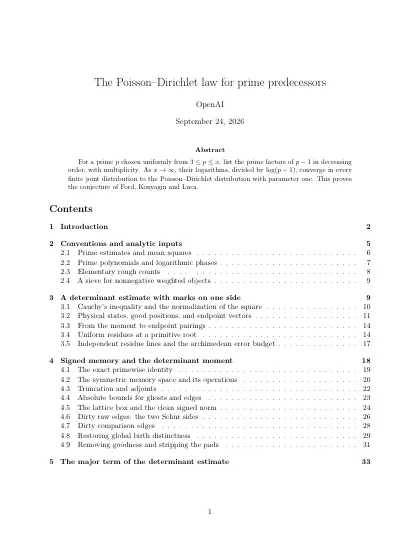
First page of The Poisson-Dirichlet law for prime predecessors

The Poisson-Dirichlet law for prime predecessors

OpenAI · September 24, 2026

For a prime p chosen uniformly from \(3\le p\le x\), list the prime factors of \(p-1\) in decreasing order, with multiplicity. As \(x\to\infty\), their logarithms, divided by \(\log(p-1)\), converge in every finite joint distribution to the Poisson–Dirichlet distribution with parameter one. This proves the conjecture of Ford, Konyagin and Luca.

Read PDF Download Source

Cite
@misc{OAI:The-Poisson-Dirichlet-Law-for-Prime-Predecessors-September-24-2026,
  author = {{OpenAI}},
  title = {{The Poisson--Dirichlet law for prime predecessors}},
  howpublished = {OpenAI Math Release preprint
                  \href{https://github.com/openai/math/blob/main/preprints/The-Poisson-Dirichlet-Law-for-Prime-Predecessors-September-24-2026/paper.pdf}{OAI:The-Poisson-Dirichlet-Law-for-Prime-Predecessors-September-24-2026}},
  year = {2026}
}
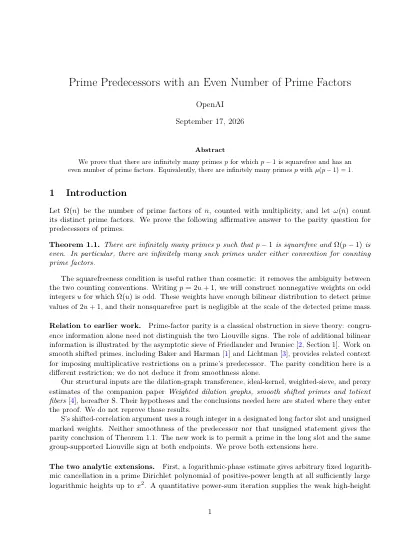
First page of Prime Predecessors with an Even Number of Prime Factors

Prime Predecessors with an Even Number of Prime Factors

OpenAI · September 17, 2026

We prove that there are infinitely many primes p for which \(p-1\) is squarefree and has an even number of prime factors. Equivalently, there are infinitely many primes p with \(\mu(p-1)=1\).

Read PDF Download Source

Cite
@misc{OAI:Prime-Predecessors-with-an-Even-Number-of-Prime-Factors-September-17-2026,
  author = {{OpenAI}},
  title = {{Prime Predecessors with an Even Number of Prime Factors}},
  howpublished = {OpenAI Math Release preprint
                  \href{https://github.com/openai/math/blob/main/preprints/Prime-Predecessors-with-an-Even-Number-of-Prime-Factors-September-17-2026/paper.pdf}{OAI:Prime-Predecessors-with-an-Even-Number-of-Prime-Factors-September-17-2026}},
  year = {2026}
}

Formal verification

No Lean formalization is listed for this result yet. The repository notes that unformalized results could have issues.