∑math20

Number theory · Result 025

Short Egyptian fractions

1 paperLean

Every rational \(a/b\) with \(1\le a\lt b\) is a sum of \(O(\log\log b)\) distinct positive unit fractions. The worst-case minimum number of terms has the same order, resolving Erdős’s conjecture on short Egyptian fractions.

Watch

▶Introduction: the problem and why it mattersin preparation
▶The presented solutionin preparation

Papers 1

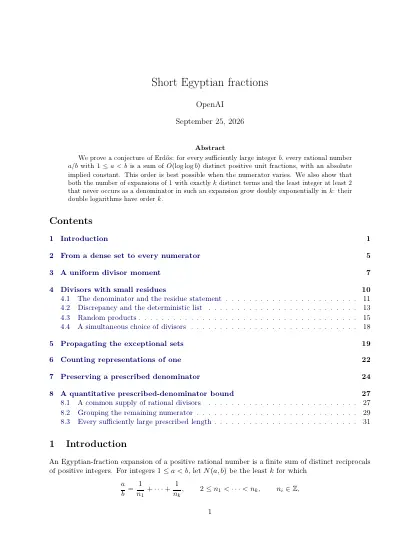
First page of Short Egyptian fractions

Short Egyptian fractions

OpenAI · September 25, 2026

We prove a conjecture of Erdős: for every sufficiently large integer b, every rational number \(a/b\) with \(1\le a\lt b\) is a sum of \(O(\log\log b)\) distinct positive unit fractions, with an absolute implied constant. This order is best possible when the numerator varies. We also show that both the number of expansions of 1 with exactly k distinct terms and the least integer at least 2 that never occurs as a denominator in such an expansion grow doubly exponentially in k: their double logarithms have order k.

Read PDF Download Source

Cite
@misc{OAI:Short-Egyptian-fractions-September-25-2026,
  author = {{OpenAI}},
  title = {{Short Egyptian fractions}},
  howpublished = {OpenAI Math Release preprint
                  \href{https://github.com/openai/math/blob/main/preprints/Short-Egyptian-fractions-September-25-2026/Short-Egyptian-fractions-September-25-2026.pdf}{OAI:Short-Egyptian-fractions-September-25-2026}},
  year = {2026}
}

What was formalized in Lean

The following describes the scope of the Lean formalization related to the following accompanying paper(s):

Scope

An Egyptian-fraction expansion writes a rational number as a sum of distinct unit fractions. The formalization proves that every \(a/b\) with \(1\le a<b\) has such an expansion and that the largest minimum length at denominator \(b\) is \(\Theta(\log\log b)\). If \(F(k)\) counts exact \(k\)-term expansions of \(1\), it also proves \(\log\log F(k)=\Theta(k)\) and bounds every denominator in such an expansion.

Every integer \(m\ge2\) occurs as a denominator in an expansion of \(1\), with length eventually at most \((257/\log2+\varepsilon)\log\log m\) for every \(\varepsilon>0\); padding can preserve that denominator. If \(v(k)\) is the least integer at least \(2\) absent from all exact \(k\)-term expansions of \(1\), then eventually \(e^{e^{k/600}}\le v(k)\le1+k^{2^{k-1}}\), and \(\liminf_{k\to\infty}\log\log v(k)/k\ge\log2/257\).

Comparator links

ResultComparator statement
Short expansions, counting, and prescribed denominatorsEgyptianFractions.lean
Optimal order of the shortest Egyptian-fraction expansionsShortEgyptianFractions.lean

Scope note on GitHub →