∑math20

Number theory · Result 027

Potential integral density on curve character varieties

1 paperLean

Resolves the determinant-one curve case of Litt's integral-density question. For every smooth connected complex algebraic curve and every rank, integral points become Zariski dense in every component of its SLr character variety over the full ring of integers of one number field. Prescribed quasi-unipotent boundary conjugacy classes are allowed, including nonsemisimple classes.

Watch

1

The problem

What is being asked, where it comes from, and why it is hard. No proof needed.

▶Introduction to the problemin preparation
2

The solution proposed by OpenAI

How the paper solves it, step by step.

Full explanation
▶The proposed solutionin preparation

Papers 1

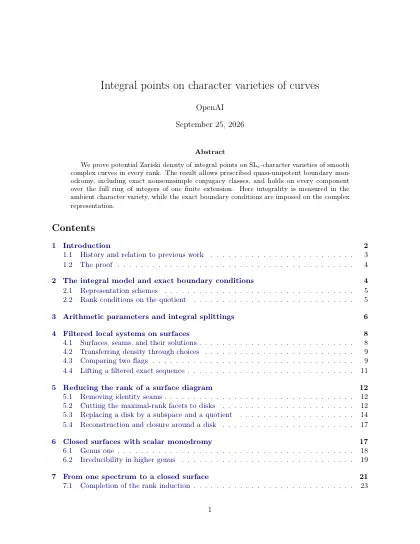
First page of Integral points on character varieties of curves

Integral points on character varieties of curves

OpenAI · September 25, 2026

We prove potential Zariski density of integral points on SLr-character varieties of smooth complex curves in every rank. The result allows prescribed quasi-unipotent boundary monodromy, including exact nonsemisimple conjugacy classes, and holds on every component over the full ring of integers of one finite extension. Here integrality is measured in the ambient character variety, while the exact boundary conditions are imposed on the complex representation.

Read PDF Download Source

Cite
@misc{OAI:Integral-points-on-character-varieties-of-curves-September-25-2026,
  author = {{OpenAI}},
  title = {{Integral points on character varieties of curves}},
  howpublished = {OpenAI Math Release preprint
                  \href{https://github.com/openai/math/blob/main/preprints/Integral-points-on-character-varieties-of-curves-September-25-2026/paper.pdf}{OAI:Integral-points-on-character-varieties-of-curves-September-25-2026}},
  year = {2026}
}

What was formalized in Lean

The following describes the scope of the Lean formalization related to the following accompanying paper(s):

Scope

The integral-density question asks whether integral points become Zariski dense in every component of a curve character variety after one finite extension of the number field. The linked formalization proves a supporting compatibility result for its marked-surface construction. Given a proper diagram with finitely many vertices, a chosen seam with maximal adjacent facet rank and a positive-genus parent, puncture data, an existing solution over a field, and a chosen boundary occurrence, the produced marked values satisfy every seam equation.

This is conditional compatibility of the produced solution. Potential integral density, including the prescribed-boundary and all-component conclusions, remains outside the selected statement.

Comparator links

ResultComparator statement
Compatibility of the produced marked solution with every seam equationCharacterVarietiesAllSeamsSupport.lean

Scope note on GitHub →