∑math20

Real and complex analysis · Result 076

Real ultraflat Littlewood polynomials and unbounded binary merit factors

3 papersLean

Constructs polynomials with N consecutive coefficients in \(\{-1,1\}\) whose modulus is \((1+o(1))\sqrt N\) uniformly on the entire unit circle, for every sufficiently large integer length N. Thus real Littlewood polynomials are ultraflat, including at the real endpoints. Their binary merit factors tend to infinity, disproving Turyn's bounded-merit-factor conjecture.

Watch

1

The problem

What is being asked, where it comes from, and why it is hard. No proof needed.

▶Introduction to the problemin preparation
2

The solution proposed by OpenAI

How the paper solves it, step by step.

Full explanation
▶The proposed solutionin preparation

Papers 3

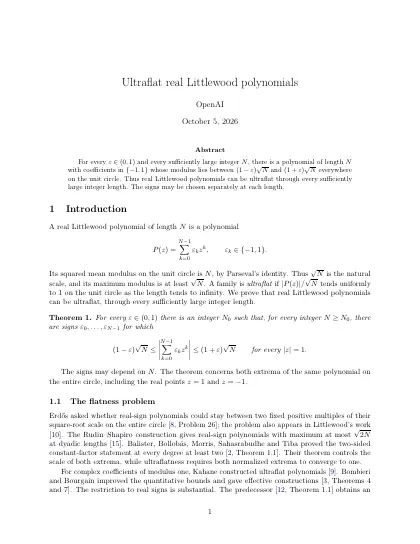
First page of Ultraflat real Littlewood polynomials

Ultraflat real Littlewood polynomials

OpenAI · October 5, 2026

For every \(\varepsilon\in(0,1)\) and every sufficiently large integer N, there is a polynomial of length N with coefficients in \(\{-1,1\}\) whose modulus lies between \((1-\varepsilon)\sqrt N\) and \((1+\varepsilon)\sqrt N\) everywhere on the unit circle. Thus real Littlewood polynomials can be ultraflat through every sufficiently large integer length. The signs may be chosen separately at each length.

Read PDF Download Source

Cite
@misc{OAI:Ultraflat-real-Littlewood-polynomials-October-5-2026,
  author = {{OpenAI}},
  title = {{Ultraflat real Littlewood polynomials}},
  howpublished = {OpenAI Math Release preprint
                  \href{https://github.com/openai/math/blob/main/preprints/Ultraflat-real-Littlewood-polynomials-October-5-2026/ultraflat-real-littlewood-polynomials.pdf}{OAI:Ultraflat-real-Littlewood-polynomials-October-5-2026}},
  year = {2026}
}
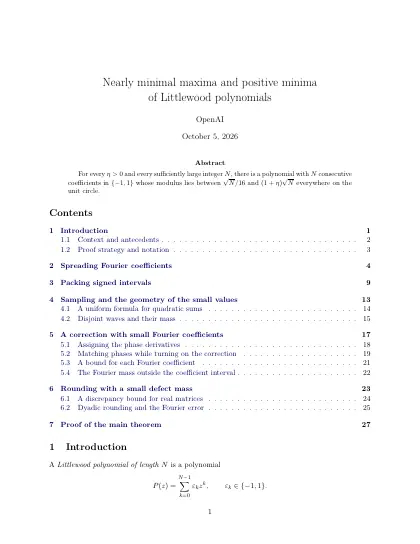
First page of Nearly minimal maxima and positive minima of Littlewood polynomials

Nearly minimal maxima and positive minima of Littlewood polynomials

OpenAI · October 5, 2026

For every η > 0 and every sufficiently large integer N, there is a polynomial with N consecutive coefficients in \(\{-1,1\}\) whose modulus lies between \(\sqrt N/16\) and \((1+\eta)\sqrt N\) everywhere on the unit circle.

Read PDF Download Source

Cite
@misc{OAI:Nearly-minimal-maxima-and-positive-minima-of-Littlewood-polynomials-October-5-2026,
  author = {{OpenAI}},
  title = {{Nearly minimal maxima and positive minima of Littlewood polynomials}},
  howpublished = {OpenAI Math Release preprint
                  \href{https://github.com/openai/math/blob/main/preprints/Nearly-minimal-maxima-and-positive-minima-of-Littlewood-polynomials-October-5-2026/littlewood-lower-envelope.pdf}{OAI:Nearly-minimal-maxima-and-positive-minima-of-Littlewood-polynomials-October-5-2026}},
  year = {2026}
}
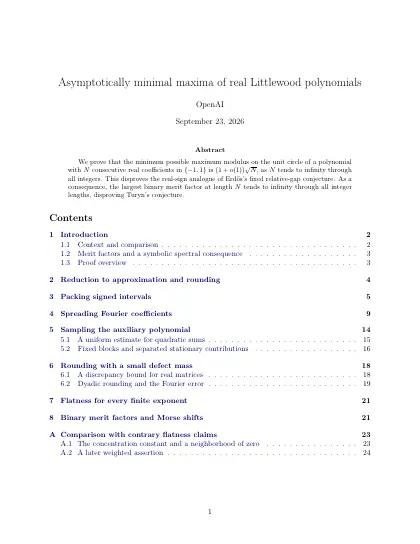
First page of Asymptotically minimal maxima of real Littlewood polynomials

Asymptotically minimal maxima of real Littlewood polynomials

OpenAI · September 23, 2026

We prove that the minimum possible maximum modulus on the unit circle of a polynomial with N consecutive real coefficients in \(\{-1,1\}\) is \((1+o(1))\sqrt N\), as N tends to infinity through all integers. This disproves the real-sign analogue of Erdős's fixed relative-gap conjecture. As a consequence, the largest binary merit factor at length N tends to infinity through all integer lengths, disproving Turyn's conjecture.

Read PDF Download Source

Cite
@misc{OAI:Asymptotically-minimal-maxima-of-real-Littlewood-polynomials-September-23-2026,
  author = {{OpenAI}},
  title = {{Asymptotically minimal maxima of real Littlewood polynomials}},
  howpublished = {OpenAI Math Release preprint
                  \href{https://github.com/openai/math/blob/main/preprints/Asymptotically-minimal-maxima-of-real-Littlewood-polynomials-September-23-2026/paper.pdf}{OAI:Asymptotically-minimal-maxima-of-real-Littlewood-polynomials-September-23-2026}},
  year = {2026}
}

What was formalized in Lean

The following describes the scope of the Lean formalization related to the following accompanying paper(s):

Scope

The formalization gives real Littlewood polynomials of every sufficiently large length whose maximum modulus on the unit circle is at most \((1+\eta)\sqrt N\) for any fixed \(\eta>0\). Thus the smallest possible maximum is asymptotically minimal through all integer lengths.

A further statement chooses one family of real sign polynomials for all lengths such that, for every fixed finite \(p>0\), the \(L^p\) mean of \(\bigl||P_N(z)|/\sqrt N-1\bigr|\) on the unit circle tends to zero. The results are existential and do not give an effective convergence rate or a signing algorithm.

Comparator links

ResultComparator statement
Asymptotically minimal Littlewood maximumAsymptoticallyMinimalLittlewood.lean
Finite-exponent flatness of one all-length Littlewood familyLittlewoodFiniteFlatness.lean

Scope note on GitHub →