∑math20

Real and complex analysis · Result 080

The exact Sobolev endpoint for Schrödinger convergence

2 papers

Proves almost-everywhere convergence \(e^{it\Delta}f\to f\) as \(t\downarrow0\) for every \(f\in H^{n/(2(n+1))}(\mathbb R^n)\) and every dimension n ≥ 2. This attains the sharp Sobolev equality case of Carleson's Schrödinger convergence problem, including the planar endpoint H1/3.

Watch

▶Introduction: the problem and why it mattersin preparation
▶The presented solutionin preparation

Papers 2

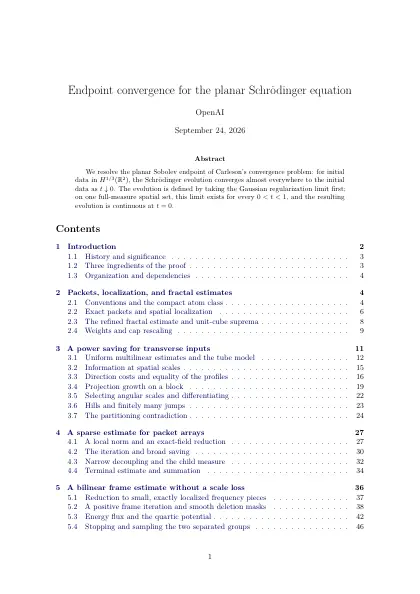
First page of Endpoint convergence for the planar Schrodinger equation

Endpoint convergence for the planar Schrodinger equation

OpenAI · September 24, 2026

We resolve the planar Sobolev endpoint of Carleson's convergence problem: for initial data in \(H^{1/3}(\mathbb R^2)\), the Schrödinger evolution converges almost everywhere to the initial data as \(t\downarrow0\). The evolution is defined by taking the Gaussian regularization limit first; on one full-measure spatial set, this limit exists for every \(0\lt t\lt 1\), and the resulting evolution is continuous at t = 0.

Read PDF Download Source

Cite
@misc{OAI:Endpoint-convergence-for-the-planar-Schrodinger-equation-September-24-2026,
  author = {{OpenAI}},
  title = {{Endpoint convergence for the planar Schr\"odinger equation}},
  howpublished = {OpenAI Math Release preprint
                  \href{https://github.com/openai/math/blob/main/preprints/Endpoint-convergence-for-the-planar-Schrodinger-equation-September-24-2026/paper.pdf}{OAI:Endpoint-convergence-for-the-planar-Schrodinger-equation-September-24-2026}},
  year = {2026}
}
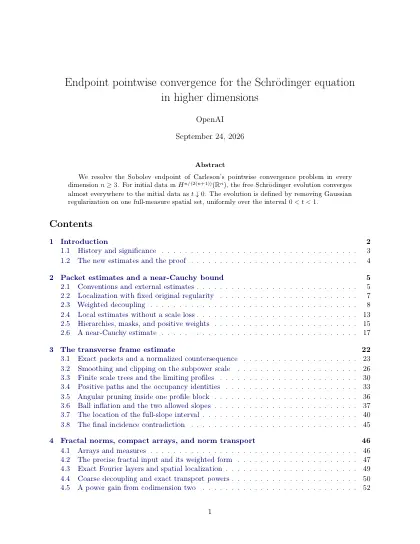
First page of Endpoint pointwise convergence for the Schrodinger equation in higher dimensions

Endpoint pointwise convergence for the Schrodinger equation in higher dimensions

OpenAI · September 24, 2026

We resolve the Sobolev endpoint of Carleson's pointwise convergence problem in every dimension n ≥ 3. For initial data in \(H^{n/(2(n+1))}(\mathbb R^n)\), the free Schrödinger evolution converges almost everywhere to the initial data as \(t\downarrow0\). The evolution is defined by removing Gaussian regularization on one full-measure spatial set, uniformly over the interval \(0\lt t\lt 1\).

Read PDF Download Source

Cite
@misc{OAI:Endpoint-pointwise-convergence-for-the-Schrodinger-equation-in-higher-dimensions-September-24-2026,
  author = {{OpenAI}},
  title = {{Endpoint pointwise convergence for the Schr\"odinger equation in higher dimensions}},
  howpublished = {OpenAI Math Release preprint
                  \href{https://github.com/openai/math/blob/main/preprints/Endpoint-pointwise-convergence-for-the-Schrodinger-equation-in-higher-dimensions-September-24-2026/paper.pdf}{OAI:Endpoint-pointwise-convergence-for-the-Schrodinger-equation-in-higher-dimensions-September-24-2026}},
  year = {2026}
}

Formal verification

No Lean formalization is listed for this result yet. The repository notes that unformalized results could have issues.