∑math20

Real and complex analysis · Result 084

The geometric case of the Erdős similarity conjecture

2 papersLean

For every fixed \(q\in(0,1)\), constructs compact subsets of \([0,1]\) with measure arbitrarily close to one containing no translated and nontrivially dilated copy of \(\{q^n:n\ge1\}\), with dilations of either sign. This resolves the geometric-progression case of the Erdős similarity conjecture for every ratio.

Watch

1

The problem

What is being asked, where it comes from, and why it is hard. No proof needed.

▶Introduction to the problemin preparation
2

The solution proposed by OpenAI

How the paper solves it, step by step.

Full explanation
▶The proposed solutionin preparation

Papers 2

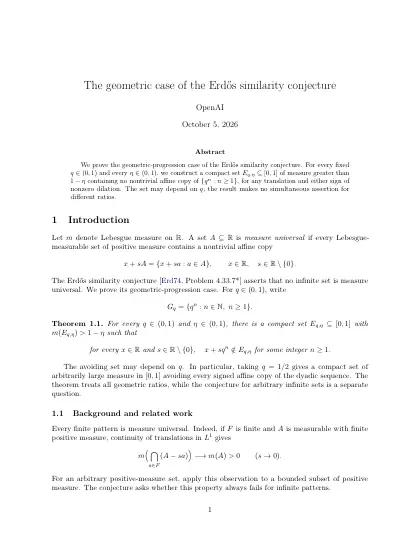
First page of The geometric case of the Erdős similarity conjecture

The geometric case of the Erdős similarity conjecture

OpenAI · October 5, 2026

We prove the geometric-progression case of the Erdős similarity conjecture. For every fixed \(q\in(0,1)\) and every \(\eta\in(0,1)\), we construct a compact set \(E_{q,\eta}\subseteq[0,1]\) of measure greater than \(1-\eta\) containing no nontrivial affine copy of \(\{q^n:n\ge1\}\), for any translation and either sign of nonzero dilation. The set may depend on q; the result makes no simultaneous assertion for different ratios.

Read PDF Download Source

Cite
@misc{OAI:The-geometric-case-of-the-Erdos-similarity-conjecture-October-5-2026,
  author = {{OpenAI}},
  title = {{The geometric case of the Erd\H{o}s similarity conjecture}},
  howpublished = {OpenAI Math Release preprint
                  \href{https://github.com/openai/math/blob/main/preprints/The-geometric-case-of-the-Erdos-similarity-conjecture-October-5-2026/geometric-erdos-similarity.pdf}{OAI:The-geometric-case-of-the-Erdos-similarity-conjecture-October-5-2026}},
  year = {2026}
}
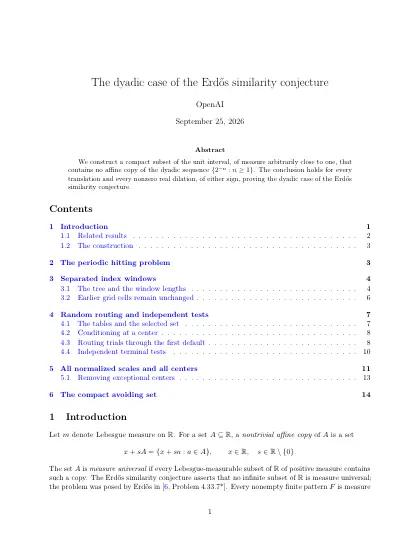
First page of The dyadic case of the Erdős similarity conjecture

The dyadic case of the Erdős similarity conjecture

OpenAI · September 25, 2026

We construct a compact subset of the unit interval, of measure arbitrarily close to one, that contains no affine copy of the dyadic sequence \(\{2^{-n}:n\ge1\}\). The conclusion holds for every translation and every nonzero real dilation, of either sign, proving the dyadic case of the Erdős similarity conjecture.

Read PDF Download Source

Cite
@misc{OAI:The-dyadic-case-of-the-Erdos-similarity-conjecture-September-25-2026,
  author = {{OpenAI}},
  title = {{The dyadic case of the Erd\H{o}s similarity conjecture}},
  howpublished = {OpenAI Math Release preprint
                  \href{https://github.com/openai/math/blob/main/preprints/The-dyadic-case-of-the-Erdos-similarity-conjecture-September-25-2026/paper.pdf}{OAI:The-dyadic-case-of-the-Erdos-similarity-conjecture-September-25-2026}},
  year = {2026}
}

What was formalized in Lean

The following describes the scope of the Lean formalization related to the following accompanying paper(s):

Scope

The formalization proves the dyadic case of the Erdős similarity conjecture. For every \(0<\eta<1\), it constructs a compact set \(E\subset[0,1]\) of measure greater than \(1-\eta\) that contains no affine copy of \(\{2^{-n}:n\ge1\}\). Explicitly, for every translation \(x\) and every nonzero real dilation \(s\), some point \(x+s2^{-n}\) lies outside \(E\). Both signs of \(s\) are included.

Comparator links

ResultComparator statement
Positive-measure avoidance of every affine dyadic sequenceDyadicAvoidance.lean

Scope note on GitHub →