∑math20

Theoretical computer science · Result 109

Integer multiplication below \(n\log n\)

1 paper

Multiplies two n-bit integers exactly at every input length in deterministic worst-case time \(O(n(\log n)^{1-\kappa})\), with \(\kappa=2^{-182}\), on one fixed finite-alphabet Turing machine with finitely many one-dimensional tapes. This disproves the Schönhage–Strassen \(n\log n\) optimality conjecture in the ordinary multitape bit model.

Watch

1

The problem

What is being asked, where it comes from, and why it is hard. No proof needed.

▶Introduction to the problemin preparation
2

The solution proposed by OpenAI

How the paper solves it, step by step.

Full explanation
▶The proposed solutionin preparation

Papers 1

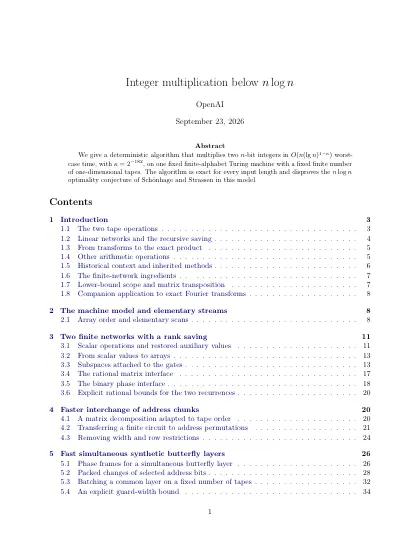
First page of Integer multiplication below n log n

Integer multiplication below n log n

OpenAI · September 23, 2026

We give a deterministic algorithm that multiplies two n-bit integers in \(O(n(\lg n)^{1-\kappa})\) worst-case time, with \(\kappa=2^{-182}\), on one fixed finite-alphabet Turing machine with a fixed finite number of one-dimensional tapes. The algorithm is exact for every input length and disproves the \(n\log n\) optimality conjecture of Schönhage and Strassen in this model.

Read PDF Download Source

Cite
@misc{OAI:Integer-multiplication-below-n-log-n-September-23-2026,
  author = {{OpenAI}},
  title = {{Integer multiplication below $n\log n$}},
  howpublished = {OpenAI Math Release preprint
                  \href{https://github.com/openai/math/blob/main/preprints/Integer-multiplication-below-n-log-n-September-23-2026/paper.pdf}{OAI:Integer-multiplication-below-n-log-n-September-23-2026}},
  year = {2026}
}

Formal verification

No Lean formalization is listed for this result yet. The repository notes that unformalized results could have issues.