∑math20

Probability and statistical mechanics · Result 215

Canonical \(O(3)\) continuum limit and exact \(O(4)\) mass asymptotics

5 papersLean

Constructs the canonical continuum limit of the two-dimensional nearest-neighbor \(O(3)\) model: a non-Gaussian local relativistic theory with a unique vacuum and a positive mass gap. For the square-lattice \(O(4)\) model, determines the exact leading asymptotic of the full transfer gap, \(m_{\mathrm{lat}}(\beta)\sim32e^{\pi/4-1/2}\sqrt\beta\,e^{-\pi\beta}\). The family also proves exponential spin-correlation decay for two-dimensional nearest-neighbor \(O(n)\) models with n ≥ 3 at every positive temperature.

Watch

▶Introduction: the problem and why it mattersin preparation
▶The presented solutionin preparation

Papers 5

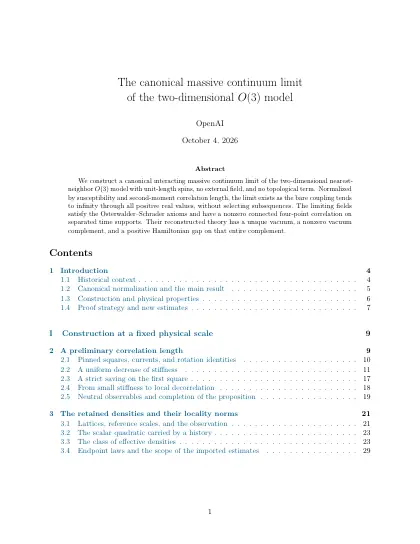
First page of The canonical massive continuum limit of the two-dimensional O(3) model

The canonical massive continuum limit of the two-dimensional O(3) model

OpenAI · October 4, 2026

We construct a canonical interacting massive continuum limit of the two-dimensional nearest-neighbor \(O(3)\) model with unit-length spins, no external field, and no topological term. Normalized by susceptibility and second-moment correlation length, the limit exists as the bare coupling tends to infinity through all positive real values, without selecting subsequences. The limiting fields satisfy the Osterwalder–Schrader axioms and have a nonzero connected four-point correlation on separated time supports. Their reconstructed theory has a unique vacuum, a nonzero vacuum complement, and a positive Hamiltonian gap on that entire complement.

Read PDF Download Source

Cite
@misc{OAI:The-canonical-massive-continuum-limit-of-the-two-dimensional-O3-model-October-4-2026,
  author = {{OpenAI}},
  title = {{The canonical massive continuum limit of the two-dimensional O(3) model}},
  howpublished = {OpenAI Math Release preprint
                  \href{https://github.com/openai/math/blob/main/preprints/The-canonical-massive-continuum-limit-of-the-two-dimensional-O3-model-October-4-2026/massive-continuum-o3.pdf}{OAI:The-canonical-massive-continuum-limit-of-the-two-dimensional-O3-model-October-4-2026}},
  year = {2026}
}
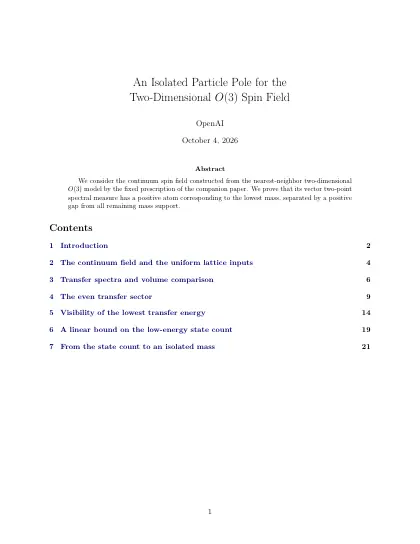
First page of An Isolated Particle Pole for the Two-Dimensional O(3) Spin Field

An Isolated Particle Pole for the Two-Dimensional O(3) Spin Field

OpenAI · October 4, 2026

We consider the continuum spin field constructed from the nearest-neighbor two-dimensional \(O(3)\) model by the fixed prescription of the companion paper. We prove that its vector two-point spectral measure has a positive atom corresponding to the lowest mass, separated by a positive gap from all remaining mass support.

Read PDF Download Source

Cite
@misc{OAI:An-Isolated-Particle-Pole-for-the-Two-Dimensional-O3-Spin-Field-October-4-2026,
  author = {{OpenAI}},
  title = {{An Isolated Particle Pole for the Two-Dimensional O(3) Spin Field}},
  howpublished = {OpenAI Math Release preprint
                  \href{https://github.com/openai/math/blob/main/preprints/An-Isolated-Particle-Pole-for-the-Two-Dimensional-O3-Spin-Field-October-4-2026/o3-particle-pole.pdf}{OAI:An-Isolated-Particle-Pole-for-the-Two-Dimensional-O3-Spin-Field-October-4-2026}},
  year = {2026}
}
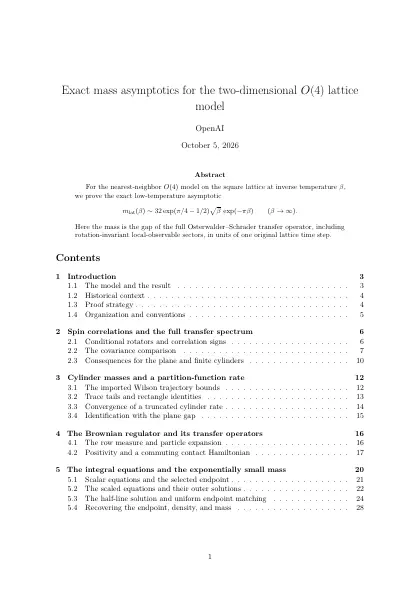
First page of Exact mass asymptotics for the two-dimensional O(4) lattice model

Exact mass asymptotics for the two-dimensional O(4) lattice model

OpenAI · October 5, 2026

For the nearest-neighbor \(O(4)\) model on the square lattice at inverse temperature β, we prove the exact low-temperature asymptotic \(\displaystyle m_{\mathrm{lat}}(\beta)\sim 32\exp(\pi/4-1/2)\sqrt\beta\,\exp(-\pi\beta) \qquad (\beta\to\infty).\) Here the mass is the gap of the full Osterwalder–Schrader transfer operator, including rotation-invariant local-observable sectors, in units of one original lattice time step.

Read PDF Download Source

Cite
@misc{OAI:Exact-mass-asymptotics-for-the-two-dimensional-O4-lattice-model-October-5-2026,
  author = {{OpenAI}},
  title = {{Exact mass asymptotics for the two-dimensional O(4) lattice model}},
  howpublished = {OpenAI Math Release preprint
                  \href{https://github.com/openai/math/blob/main/preprints/Exact-mass-asymptotics-for-the-two-dimensional-O4-lattice-model-October-5-2026/exact-mass-o4.pdf}{OAI:Exact-mass-asymptotics-for-the-two-dimensional-O4-lattice-model-October-5-2026}},
  year = {2026}
}
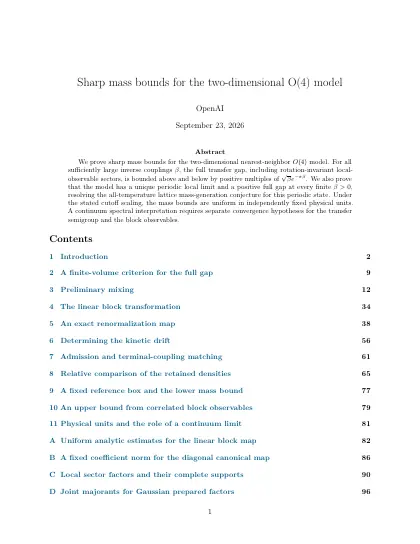
First page of Sharp mass bounds for the two-dimensional O(4) model

Sharp mass bounds for the two-dimensional O(4) model

OpenAI · September 23, 2026

We prove sharp mass bounds for the two-dimensional nearest-neighbor \(O(4)\) model. For all sufficiently large inverse couplings β, the full transfer gap, including rotation-invariant local-observable sectors, is bounded above and below by positive multiples of \(\sqrt\beta e^{-\pi\beta}\). We also prove that the model has a unique periodic local limit and a positive full gap at every finite β > 0, resolving the all-temperature lattice mass-generation conjecture for this periodic state. Under the stated cutoff scaling, the mass bounds are uniform in independently fixed physical units. A continuum spectral interpretation requires separate convergence hypotheses for the transfer semigroup and the block observables.

Read PDF Download Source

Cite
@misc{OAI:Sharp-mass-bounds-for-the-two-dimensional-O4-model-September-23-2026,
  author = {{OpenAI}},
  title = {{Sharp mass bounds for the two-dimensional O(4) model}},
  howpublished = {OpenAI Math Release preprint
                  \href{https://github.com/openai/math/blob/main/preprints/Sharp-mass-bounds-for-the-two-dimensional-O4-model-September-23-2026/paper.pdf}{OAI:Sharp-mass-bounds-for-the-two-dimensional-O4-model-September-23-2026}},
  year = {2026}
}
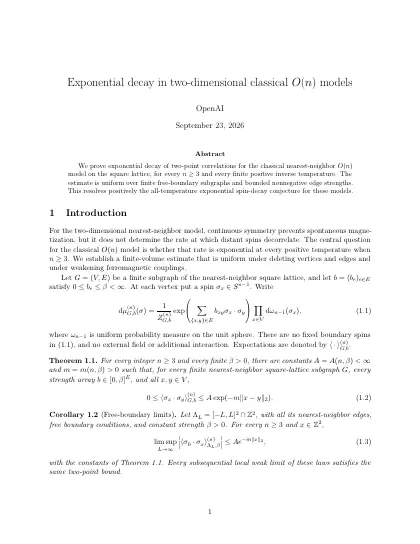
First page of Exponential decay in two-dimensional classical O(n) models

Exponential decay in two-dimensional classical O(n) models

OpenAI · September 23, 2026

We prove exponential decay of two-point correlations for the classical nearest-neighbor \(O(n)\) model on the square lattice, for every n ≥ 3 and every finite positive inverse temperature. The estimate is uniform over finite free-boundary subgraphs and bounded nonnegative edge strengths. This resolves positively the all-temperature exponential spin-decay conjecture for these models.

Read PDF Download Source

Cite
@misc{OAI:Exponential-decay-in-two-dimensional-classical-On-models-September-23-2026,
  author = {{OpenAI}},
  title = {{Exponential decay in two-dimensional classical $O(n)$ models}},
  howpublished = {OpenAI Math Release preprint
                  \href{https://github.com/openai/math/blob/main/preprints/Exponential-decay-in-two-dimensional-classical-On-models-September-23-2026/paper.pdf}{OAI:Exponential-decay-in-two-dimensional-classical-On-models-September-23-2026}},
  year = {2026}
}

What was formalized in Lean

The following describes the scope of the Lean formalization related to the following accompanying paper(s):

Scope

The formalized result proves exponential decay of spin correlations for the two-dimensional classical \(O(n)\) model at every temperature when \(n\ge3\). For each interaction bound \(\beta>0\), constants \(A\) and \(m>0\) work for every finite square-lattice subgraph with free boundary and nonnegative edge strengths at most \(\beta\): the correlation between sites \(x,y\) is at most \(Ae^{-m|x-y|}\). The infinite-volume limit and the separate \(O(4)\) spectral-gap claim are not included.

Comparator links

ResultComparator statement
Exponential correlation decay for classical \(O(n)\) modelsClassicalON.lean

Scope note on GitHub →