∑math20

Group theory · Result 247

An infinite finitely presented residually finite 2-group and a finitely presented nil algebra

2 papersLean

Constructs an infinite finitely presented residually finite group whose elements all have finite 2-power order, answering the finitely presented Burnside problem negatively even in this class. The construction also yields an infinite-dimensional finitely presented nil associative 𝔽2-algebra and a finitely presented infinite-dimensional algebraic unitization, giving negative answers to the corresponding nilpotence and Kurosh finiteness questions.

Watch

▶Introduction: the problem and why it mattersin preparation
▶The presented solutionin preparation

Papers 2

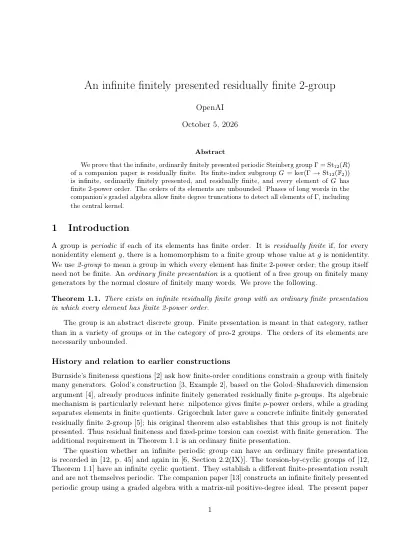
First page of An infinite finitely presented residually finite 2-group

An infinite finitely presented residually finite 2-group

OpenAI · October 5, 2026

We prove that the infinite, ordinarily finitely presented periodic Steinberg group \(\Gamma=\mathop{\mathrm{St}}\nolimits _{12}(R)\) of a companion paper is residually finite. Its finite-index subgroup \(G=\ker(\Gamma\to\mathop{\mathrm{St}}\nolimits _{12}(\mathbb F_2))\) is infinite, ordinarily finitely presented, and residually finite, and every element of G has finite 2-power order. The orders of its elements are unbounded. Phases of long words in the companion's graded algebra allow finite degree truncations to detect all elements of Γ, including the central kernel.

Read PDF Download Source

Cite
@misc{OAI:An-infinite-finitely-presented-residually-finite-2-group-October-5-2026,
  author = {{OpenAI}},
  title = {{An infinite finitely presented residually finite 2-group}},
  howpublished = {OpenAI Math Release preprint
                  \href{https://github.com/openai/math/blob/main/preprints/An-infinite-finitely-presented-residually-finite-2-group-October-5-2026/residually-finite-torsion.pdf}{OAI:An-infinite-finitely-presented-residually-finite-2-group-October-5-2026}},
  year = {2026}
}
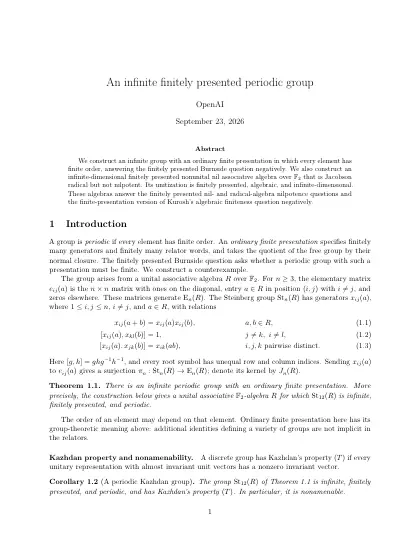
First page of An infinite finitely presented periodic group

An infinite finitely presented periodic group

OpenAI · September 23, 2026

We construct an infinite group with an ordinary finite presentation in which every element has finite order, answering the finitely presented Burnside question negatively. We also construct an infinite-dimensional finitely presented nonunital nil associative algebra over 𝔽2 that is Jacobson radical but not nilpotent. Its unitization is finitely presented, algebraic, and infinite-dimensional. These algebras answer the finitely presented nil- and radical-algebra nilpotence questions and the finite-presentation version of Kurosh's algebraic finiteness question negatively.

Read PDF Download Source

Cite
@misc{OAI:An-infinite-finitely-presented-periodic-group-September-23-2026,
  author = {{OpenAI}},
  title = {{An infinite finitely presented periodic group}},
  howpublished = {OpenAI Math Release preprint
                  \href{https://github.com/openai/math/blob/main/preprints/An-infinite-finitely-presented-periodic-group-September-23-2026/paper.pdf}{OAI:An-infinite-finitely-presented-periodic-group-September-23-2026}},
  year = {2026}
}

What was formalized in Lean

The following describes the scope of the Lean formalization related to the following accompanying paper(s):

Scope

The finitely presented Burnside question asks whether a finitely presented group in which every element has finite order must be finite. The formalization gives a negative answer by constructing an infinite finitely presented periodic group, including a witness realized as a Steinberg group over an algebra of characteristic two. Periodicity means that each element has some finite order; no common exponent is asserted. The paper's separate nil-algebra and radical-algebra conclusions are outside these selected statements.

Comparator links

ResultComparator statement
Infinite finitely presented periodic groupPeriodicGroup.lean

Scope note on GitHub →