∑math20

Mathematical physics · Result 260

Spacetime Penrose inequalities: enclosing area, charge, rotation, and anti-de Sitter extensions

13 papersLean

Proves the sharp enclosing-area spacetime Penrose inequality for smooth one-ended asymptotically flat initial data in every spatial dimension n ≥ 3, under dominant energy, weak future trapping, positive enclosing area, and the stated decay assumptions. It bounds invariant ADM mass below using minimum enclosing area, with equality rigidity under additional horizon hypotheses. Charged upper-area bounds treat dyonic three-dimensional data; the higher-dimensional purely electric extension uses the matched neutral theorem.

Watch

1

The problem

What is being asked, where it comes from, and why it is hard. No proof needed.

▶Introduction to the problemin preparation
2

The solution proposed by OpenAI

How the paper solves it, step by step.

Full explanation
▶The proposed solutionin preparation

Papers 13

First page of The spacetime Penrose inequality with charge and original-data rigidity

The spacetime Penrose inequality with charge and original-data rigidity

OpenAI · October 5, 2026

Under the stated energy, decay, and trapping hypotheses, we prove the sharp charged spacetime Penrose upper-area inequality for one-ended three-dimensional initial data with source-free electric and magnetic fields. The theorem allows arbitrary second fundamental form, nonzero ADM momentum, and disconnected boundary. Writing m for invariant ADM mass, Q for total charge magnitude, and rA for the minimum-enclosing-area radius, the bound is m ≥ Q and \(r_A\le m+\sqrt{m^2-Q^2}\). The polynomial mass bound \(m\ge(r_A+Q^2/r_A)/2\) is asserted only when \(r_A\gt Q\). When m > Q, equality under the stated connected, outermost, outer-area-minimizing future-horizon hypotheses identifies the original data as a smooth spacelike slice of dyonic Reissner–Nordström, including smooth attachment at the future horizon.

Read PDF Download Source

Cite
@misc{OAI:The-spacetime-Penrose-inequality-with-charge-and-original-data-rigidity-October-5-2026,
  author = {{OpenAI}},
  title = {{The spacetime Penrose inequality with charge and original-data rigidity}},
  howpublished = {OpenAI Math Release preprint
                  \href{https://github.com/openai/math/blob/main/preprints/The-spacetime-Penrose-inequality-with-charge-and-original-data-rigidity-October-5-2026/paper.pdf}{OAI:The-spacetime-Penrose-inequality-with-charge-and-original-data-rigidity-October-5-2026}},
  year = {2026}
}
First page of A Charged Reduction of the Spacetime Penrose Inequality in Spatial Dimensions at Least Four

A Charged Reduction of the Spacetime Penrose Inequality in Spatial Dimensions at Least Four

OpenAI · October 5, 2026

Using the companion neutral spacetime Penrose theorem exactly at its stated strong-decay, future-trapped, positive-area, and future-timelike scope, we prove the sharp purely electric upper-area inequality in every spatial dimension n ≥ 4 for one-ended charged data satisfying the charged dominant energy condition and \(\mathop{\mathrm{div}}\nolimits _g E=0\), with the specified decay, integrability, and finite-flux assumptions. The data may have arbitrary interior topology and ADM momentum, with a future or past trapping sign chosen independently on each boundary component. Positive enclosing area and strict ADM timelikeness are conclusions. The polynomial mass rearrangement is asserted only when the \((n-2)\)nd power of the enclosing-area radius exceeds \(|Q|\). When \(m\gt |Q|\), equality under the stated connected, outermost, outer-area-minimizing future-horizon hypotheses recovers the original metric, second fundamental form, and electric field as a global spacelike slice of a Reissner–Nordström–Tangherlini exterior. The equality classification includes only slices whose induced magnetic two-form vanishes.

Read PDF Download Source

Cite
@misc{OAI:A-Charged-Reduction-of-the-Spacetime-Penrose-Inequality-in-Spatial-Dimensions-at-Least-Four-October-5-2026,
  author = {{OpenAI}},
  title = {{A Charged Reduction of the Spacetime Penrose Inequality in Spatial Dimensions at Least Four}},
  howpublished = {OpenAI Math Release preprint
                  \href{https://github.com/openai/math/blob/main/preprints/A-Charged-Reduction-of-the-Spacetime-Penrose-Inequality-in-Spatial-Dimensions-at-Least-Four-October-5-2026/paper.pdf}{OAI:A-Charged-Reduction-of-the-Spacetime-Penrose-Inequality-in-Spatial-Dimensions-at-Least-Four-October-5-2026}},
  year = {2026}
}
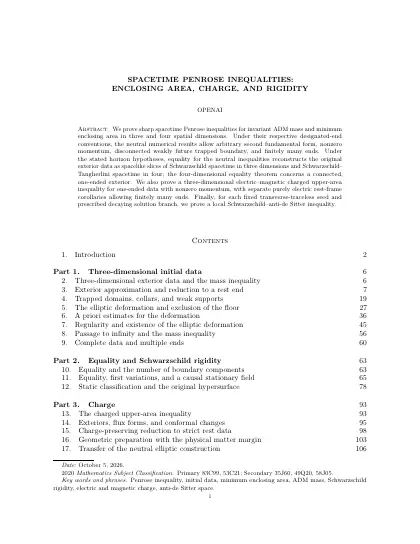
First page of Spacetime Penrose inequalities: enclosing area, charge, and rigidity

Spacetime Penrose inequalities: enclosing area, charge, and rigidity

OpenAI · October 5, 2026

We prove sharp spacetime Penrose inequalities for invariant ADM mass and minimum enclosing area in three and four spatial dimensions. Under their respective designated-end conventions, the neutral numerical results allow arbitrary second fundamental form, nonzero momentum, disconnected weakly future trapped boundary, and finitely many ends. Under the stated horizon hypotheses, equality for the neutral inequalities reconstructs the original exterior data as spacelike slices of Schwarzschild spacetime in three dimensions and Schwarzschild–Tangherlini spacetime in four; the four-dimensional equality theorem concerns a connected, one-ended exterior. We also prove a three-dimensional electric–magnetic charged upper-area inequality for one-ended data with nonzero momentum, with separate purely electric rest-frame corollaries allowing finitely many ends. Finally, for each fixed transverse-traceless seed and prescribed decaying solution branch, we prove a local Schwarzschild–anti-de Sitter inequality.

Read PDF Download Source

Cite
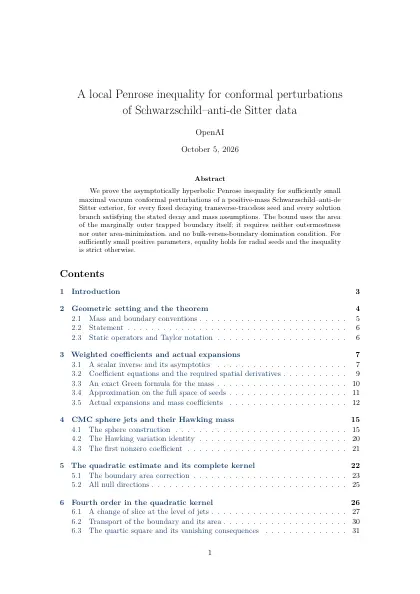
@misc{OAI:Spacetime-Penrose-inequalities-enclosing-area-charge-and-rigidity-October-5-2026,
  author = {{OpenAI}},
  title = {{Spacetime Penrose inequalities: enclosing area, charge, and rigidity}},
  howpublished = {OpenAI Math Release preprint
                  \href{https://github.com/openai/math/blob/main/preprints/Spacetime-Penrose-inequalities-enclosing-area-charge-and-rigidity-October-5-2026/paper.pdf}{OAI:Spacetime-Penrose-inequalities-enclosing-area-charge-and-rigidity-October-5-2026}},
  year = {2026}
}
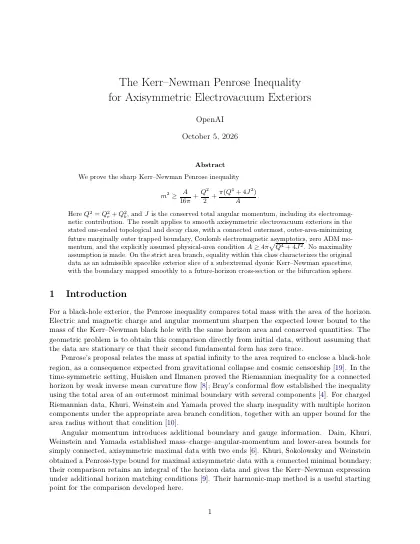
First page of The Kerr–Newman Penrose Inequality for Axisymmetric Electrovacuum Exteriors

The Kerr–Newman Penrose Inequality for Axisymmetric Electrovacuum Exteriors

OpenAI · October 5, 2026

We prove the sharp Kerr–Newman Penrose inequality \(\displaystyle m^2\ge \frac{A}{16\pi}+\frac{Q^2}{2} +\frac{\pi(Q^4+4J^2)}{A}.\) Here \(Q^2=Q_e^2+Q_b^2\), and J is the conserved total angular momentum, including its electromagnetic contribution. The result applies to smooth axisymmetric electrovacuum exteriors in the stated one-ended topological and decay class, with a connected outermost, outer-area-minimizing future marginally outer trapped boundary, Coulomb electromagnetic asymptotics, zero ADM momentum, and the explicitly assumed physical-area condition \(A\ge4\pi\sqrt{Q^4+4J^2}\). No maximality assumption is made. On the strict area branch, equality within this class characterizes the original data as an admissible spacelike exterior slice of a subextremal dyonic Kerr–Newman spacetime, with the boundary mapped smoothly to a future-horizon cross-section or the bifurcation sphere.

Read PDF Download Source

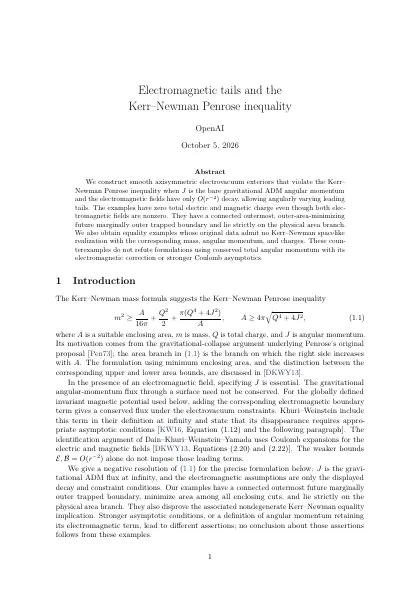
First page of Electromagnetic tails and the Kerr–Newman Penrose inequality

Electromagnetic tails and the Kerr–Newman Penrose inequality

OpenAI · October 5, 2026

We construct smooth axisymmetric electrovacuum exteriors that violate the Kerr–Newman Penrose inequality when J is the bare gravitational ADM angular momentum and the electromagnetic fields have only \(O(r^{-2})\) decay, allowing angularly varying leading tails. The examples have zero total electric and magnetic charge even though both electromagnetic fields are nonzero. They have a connected outermost, outer-area-minimizing future marginally outer trapped boundary and lie strictly on the physical area branch. We also obtain equality examples whose original data admit no Kerr–Newman spacelike realization with the corresponding mass, angular momentum, and charges. These counterexamples do not refute formulations using conserved total angular momentum with its electromagnetic correction or stronger Coulomb asymptotics.

Read PDF Download Source

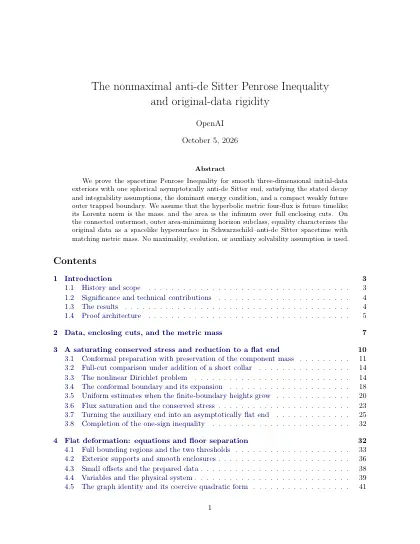
First page of The nonmaximal anti-de Sitter Penrose Inequality and original-data rigidity

The nonmaximal anti-de Sitter Penrose Inequality and original-data rigidity

OpenAI · October 5, 2026

We prove the spacetime Penrose Inequality for smooth three-dimensional initial-data exteriors with one spherical asymptotically anti-de Sitter end, satisfying the stated decay and integrability assumptions, the dominant energy condition, and a compact weakly future outer trapped boundary. We assume that the hyperbolic metric four-flux is future timelike; its Lorentz norm is the mass, and the area is the infimum over full enclosing cuts. On the connected outermost, outer area-minimizing horizon subclass, equality characterizes the original data as a spacelike hypersurface in Schwarzschild–anti-de Sitter spacetime with matching metric mass. No maximality, evolution, or auxiliary solvability assumption is used.

Read PDF Download Source

Cite
@misc{OAI:The-nonmaximal-anti-de-Sitter-Penrose-Inequality-and-original-data-rigidity-October-5-2026,
  author = {{OpenAI}},
  title = {{The nonmaximal anti-de Sitter Penrose Inequality and original-data rigidity}},
  howpublished = {OpenAI Math Release preprint
                  \href{https://github.com/openai/math/blob/main/preprints/The-nonmaximal-anti-de-Sitter-Penrose-Inequality-and-original-data-rigidity-October-5-2026/paper.pdf}{OAI:The-nonmaximal-anti-de-Sitter-Penrose-Inequality-and-original-data-rigidity-October-5-2026}},
  year = {2026}
}
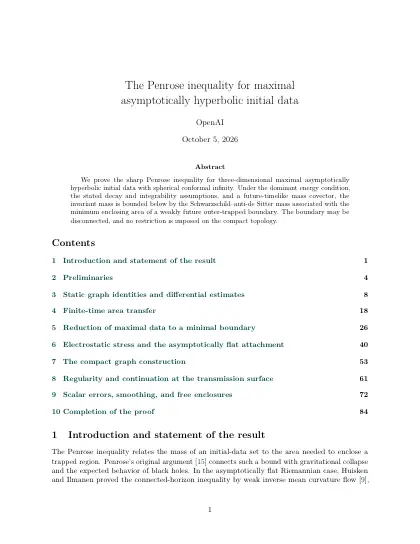
First page of The Penrose inequality for maximal asymptotically hyperbolic initial data

The Penrose inequality for maximal asymptotically hyperbolic initial data

OpenAI · October 5, 2026

We prove the sharp Penrose inequality for three-dimensional maximal asymptotically hyperbolic initial data with spherical conformal infinity. Under the dominant energy condition, the stated decay and integrability assumptions, and a future-timelike mass covector, the invariant mass is bounded below by the Schwarzschild–anti-de Sitter mass associated with the minimum enclosing area of a weakly future outer-trapped boundary. The boundary may be disconnected, and no restriction is imposed on the compact topology.

Read PDF Download Source

Cite
@misc{OAI:The-Penrose-inequality-for-maximal-asymptotically-hyperbolic-initial-data-October-5-2026,
  author = {{OpenAI}},
  title = {{The Penrose inequality for maximal asymptotically hyperbolic initial data}},
  howpublished = {OpenAI Math Release preprint
                  \href{https://github.com/openai/math/blob/main/preprints/The-Penrose-inequality-for-maximal-asymptotically-hyperbolic-initial-data-October-5-2026/paper.pdf}{OAI:The-Penrose-inequality-for-maximal-asymptotically-hyperbolic-initial-data-October-5-2026}},
  year = {2026}
}
First page of A local Penrose inequality for conformal perturbations of Schwarzschild–anti-de Sitter data

A local Penrose inequality for conformal perturbations of Schwarzschild–anti-de Sitter data

OpenAI · October 5, 2026

We prove the asymptotically hyperbolic Penrose inequality for sufficiently small maximal vacuum conformal perturbations of a positive-mass Schwarzschild–anti-de Sitter exterior, for every fixed decaying transverse-traceless seed and every solution branch satisfying the stated decay and mass assumptions. The bound uses the area of the marginally outer trapped boundary itself; it requires neither outermostness nor outer area-minimization, and no bulk-versus-boundary domination condition. For sufficiently small positive parameters, equality holds for radial seeds and the inequality is strict otherwise.

Read PDF Download Source

Cite
@misc{OAI:A-local-Penrose-inequality-for-conformal-perturbations-of-Schwarzschild-anti-de-Sitter-data-October-5-2026,
  author = {{OpenAI}},
  title = {{A local Penrose inequality for conformal perturbations of Schwarzschild--anti-de Sitter data}},
  howpublished = {OpenAI Math Release preprint
                  \href{https://github.com/openai/math/blob/main/preprints/A-local-Penrose-inequality-for-conformal-perturbations-of-Schwarzschild-anti-de-Sitter-data-October-5-2026/paper.pdf}{OAI:A-local-Penrose-inequality-for-conformal-perturbations-of-Schwarzschild-anti-de-Sitter-data-October-5-2026}},
  year = {2026}
}
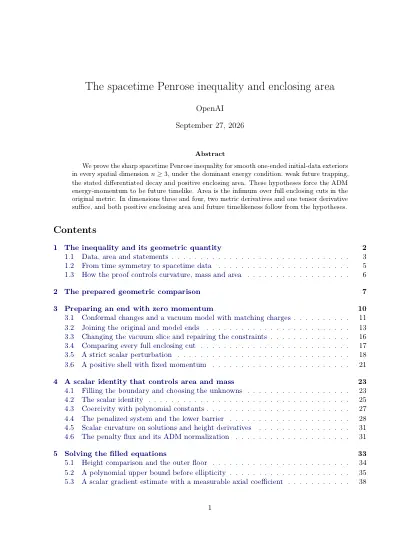
First page of The spacetime Penrose inequality and enclosing area

The spacetime Penrose inequality and enclosing area

OpenAI · September 27, 2026

We prove the sharp spacetime Penrose inequality for smooth one-ended initial-data exteriors in every spatial dimension n ≥ 3, under the dominant energy condition, weak future trapping, the stated differentiated decay and positive enclosing area. These hypotheses force the ADM energy-momentum to be future timelike. Area is the infimum over full enclosing cuts in the original metric. In dimensions three and four, two metric derivatives and one tensor derivative suffice, and both positive enclosing area and future timelikeness follow from the hypotheses.

Read PDF Download Source

Cite
@misc{OAI:The-spacetime-Penrose-inequality-and-enclosing-area-September-27-2026,
  author = {{OpenAI}},
  title = {{The spacetime Penrose inequality and enclosing area}},
  howpublished = {OpenAI Math Release preprint
                  \href{https://github.com/openai/math/blob/main/preprints/The-spacetime-Penrose-inequality-and-enclosing-area-September-27-2026/paper.pdf}{OAI:The-spacetime-Penrose-inequality-and-enclosing-area-September-27-2026}},
  year = {2026}
}
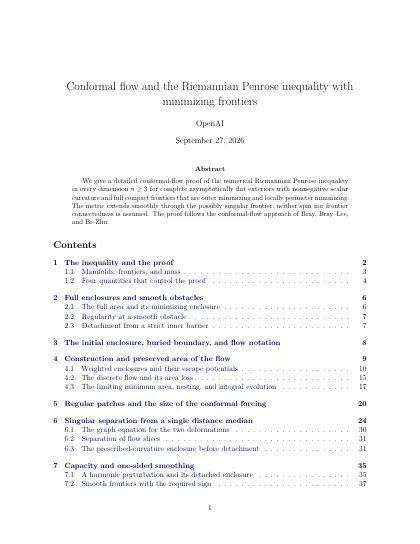
First page of Conformal flow and the Riemannian Penrose inequality with minimizing frontiers

Conformal flow and the Riemannian Penrose inequality with minimizing frontiers

OpenAI · September 27, 2026

We give a detailed conformal-flow proof of the numerical Riemannian Penrose inequality in every dimension n ≥ 3 for complete asymptotically flat exteriors with nonnegative scalar curvature and full compact frontiers that are outer minimizing and locally perimeter minimizing. The metric extends smoothly through the possibly singular frontier; neither spin nor frontier connectedness is assumed. The proof follows the conformal-flow approach of Bray, Bray–Lee, and Bi–Zhu.

Read PDF Download Source

Cite
@misc{OAI:Conformal-flow-and-the-Riemannian-Penrose-inequality-with-minimizing-frontiers-September-27-2026,
  author = {{OpenAI}},
  title = {{Conformal flow and the Riemannian Penrose inequality with minimizing frontiers}},
  howpublished = {OpenAI Math Release preprint
                  \href{https://github.com/openai/math/blob/main/preprints/Conformal-flow-and-the-Riemannian-Penrose-inequality-with-minimizing-frontiers-September-27-2026/paper.pdf}{OAI:Conformal-flow-and-the-Riemannian-Penrose-inequality-with-minimizing-frontiers-September-27-2026}},
  year = {2026}
}
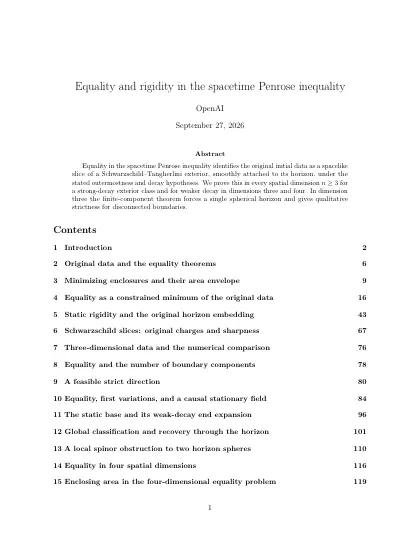
First page of Equality and rigidity in the spacetime Penrose inequality

Equality and rigidity in the spacetime Penrose inequality

OpenAI · September 27, 2026

Equality in the spacetime Penrose inequality identifies the original initial data as a spacelike slice of a Schwarzschild–Tangherlini exterior, smoothly attached to its horizon, under the stated outermostness and decay hypotheses. We prove this in every spatial dimension n ≥ 3 for a strong-decay exterior class and for weaker decay in dimensions three and four. In dimension three the finite-component theorem forces a single spherical horizon and gives qualitative strictness for disconnected boundaries.

Read PDF Download Source

Cite
@misc{OAI:Equality-and-rigidity-in-the-spacetime-Penrose-inequality-September-27-2026,
  author = {{OpenAI}},
  title = {{Equality and rigidity in the spacetime Penrose inequality}},
  howpublished = {OpenAI Math Release preprint
                  \href{https://github.com/openai/math/blob/main/preprints/Equality-and-rigidity-in-the-spacetime-Penrose-inequality-September-27-2026/paper.pdf}{OAI:Equality-and-rigidity-in-the-spacetime-Penrose-inequality-September-27-2026}},
  year = {2026}
}
First page of Boundary graph deformations for the spacetime Penrose inequality

Boundary graph deformations for the spacetime Penrose inequality

OpenAI · September 27, 2026

We construct graph and conformal deformations of trapped initial-data exteriors in three and four spatial dimensions. The resulting metrics have nonnegative scalar curvature, strictly negative inner mean curvature, a lower bound protecting every enclosing cut, and an arbitrarily small upper error in ADM energy. We also give a direct four-dimensional maximal vacuum construction that retains a noncompact decaying second fundamental form. These constructions give boundary routes to the corresponding numerical Penrose inequalities.

Read PDF Download Source

Cite
@misc{OAI:Boundary-graph-deformations-for-the-spacetime-Penrose-inequality-September-27-2026,
  author = {{OpenAI}},
  title = {{Boundary graph deformations for the spacetime Penrose inequality}},
  howpublished = {OpenAI Math Release preprint
                  \href{https://github.com/openai/math/blob/main/preprints/Boundary-graph-deformations-for-the-spacetime-Penrose-inequality-September-27-2026/paper.pdf}{OAI:Boundary-graph-deformations-for-the-spacetime-Penrose-inequality-September-27-2026}},
  year = {2026}
}
First page of Area-controlled end replacement and the Bondi Penrose inequality in the CKS class

Area-controlled end replacement and the Bondi Penrose inequality in the CKS class

OpenAI · September 27, 2026

We replace a three-dimensional Cha–Khuri–Sakovich hyperboloidal end by an asymptotically flat end while preserving the dominant energy condition and each fixed compact interior. For strictly future-timelike CKS initial-data charge, the replacements lose asymptotically no enclosing area and their ADM masses tend to the invariant Bondi mass. Combining this construction with the companion numerical spacetime Penrose theorem yields the sharp Bondi bound for possibly disconnected weakly future trapped boundaries in this class. Horizon-regular Schwarzschild exteriors attain equality at every positive mass.

Read PDF Download Source

Cite
@misc{OAI:Area-controlled-end-replacement-and-the-Bondi-Penrose-inequality-in-the-CKS-class-September-27-2026,
  author = {{OpenAI}},
  title = {{Area-controlled end replacement and the Bondi--Penrose inequality in the CKS class}},
  howpublished = {OpenAI Math Release preprint
                  \href{https://github.com/openai/math/blob/main/preprints/Area-controlled-end-replacement-and-the-Bondi-Penrose-inequality-in-the-CKS-class-September-27-2026/paper.pdf}{OAI:Area-controlled-end-replacement-and-the-Bondi-Penrose-inequality-in-the-CKS-class-September-27-2026}},
  year = {2026}
}

What was formalized in Lean

The following describes the scope of the Lean formalization related to the following accompanying paper(s):

Scope

The formalization replaces a three-dimensional Cha–Khuri–Sakovich hyperboloidal end by asymptotically flat ends while preserving each fixed compact interior, completeness, and the dominant energy condition. For strictly future-timelike initial-data charge, the ADM masses approach the invariant Bondi mass and the loss of enclosing area tends to zero.

The Comparator also includes canonical Schwarzschild equality examples at every positive mass, with \(m_{\mathrm{Bondi}}=m\) and enclosing area \(16\pi m^2\). The paper's general Bondi–Penrose inequality for possibly disconnected weakly trapped boundaries remains unformalized.

The implementation retains a conditional inequality for the connected marginal-boundary case, assuming the asymptotically flat exterior Penrose inequality. This supporting result is not selected as a substitute for the paper's main inequality.

Comparator links

ResultComparator statement
Area-controlled end replacement and Schwarzschild equality examplesCKSBondiPenrose.lean

Scope note on GitHub →