∑math20

Mathematical physics · Result 275

QMA-hardness of continuum Coulomb energy

2 papersLean

Proves QMA-hardness of approximating the electronic Coulomb energy infimum in three dimensions, minimizing over the full spinful fermionic continuum space. Deterministic polynomial-time reductions work even with only unit-charge nuclei at distinct rational positions, polynomially many electrons and an energy-threshold separation of at least one.

Watch

1

The problem

What is being asked, where it comes from, and why it is hard. No proof needed.

▶Introduction to the problemin preparation
2

The solution proposed by OpenAI

How the paper solves it, step by step.

Full explanation
▶The proposed solutionin preparation

Papers 2

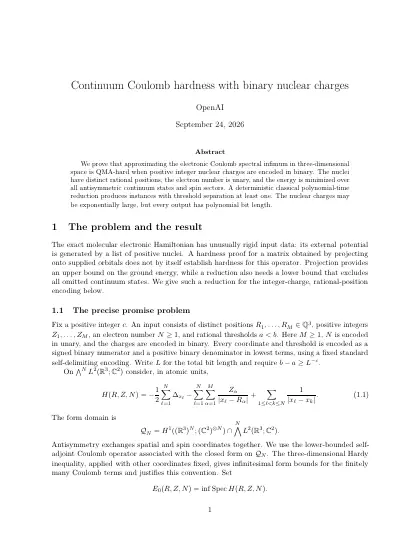
First page of Continuum Coulomb hardness with binary nuclear charges

Continuum Coulomb hardness with binary nuclear charges

OpenAI · September 24, 2026

We prove that approximating the electronic Coulomb spectral infimum in three-dimensional space is QMA-hard when positive integer nuclear charges are encoded in binary. The nuclei have distinct rational positions, the electron number is unary, and the energy is minimized over all antisymmetric continuum states and spin sectors. A deterministic classical polynomial-time reduction produces instances with threshold separation at least one. The nuclear charges may be exponentially large, but every output has polynomial bit length.

Read PDF Download Source

Cite
@misc{OAI:Continuum-Coulomb-hardness-with-binary-nuclear-charges-September-24-2026,
  author = {{OpenAI}},
  title = {{Continuum Coulomb hardness with binary nuclear charges}},
  howpublished = {OpenAI Math Release preprint
                  \href{https://github.com/openai/math/blob/main/preprints/Continuum-Coulomb-hardness-with-binary-nuclear-charges-September-24-2026/Continuum-Coulomb-hardness-with-binary-nuclear-charges-September-24-2026.pdf}{OAI:Continuum-Coulomb-hardness-with-binary-nuclear-charges-September-24-2026}},
  year = {2026}
}
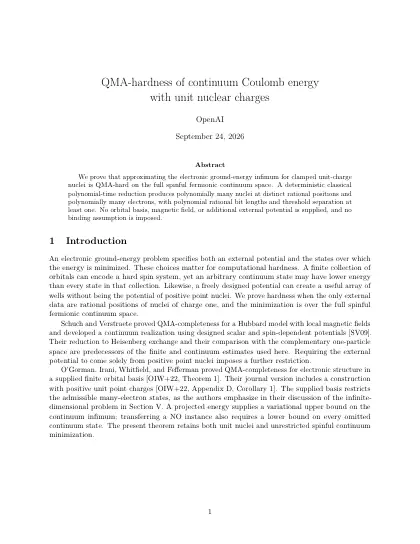
First page of QMA-hardness of continuum Coulomb energy with unit nuclear charges

QMA-hardness of continuum Coulomb energy with unit nuclear charges

OpenAI · September 24, 2026

We prove that approximating the electronic ground-energy infimum for clamped unit-charge nuclei is QMA-hard on the full spinful fermionic continuum space. A deterministic classical polynomial-time reduction produces polynomially many nuclei at distinct rational positions and polynomially many electrons, with polynomial rational bit lengths and threshold separation at least one. No orbital basis, magnetic field, or additional external potential is supplied, and no binding assumption is imposed.

Read PDF Download Source

Cite
@misc{OAI:QMA-hardness-of-continuum-Coulomb-energy-with-unit-nuclear-charges-September-24-2026,
  author = {{OpenAI}},
  title = {{QMA-hardness of continuum Coulomb energy with unit nuclear charges}},
  howpublished = {OpenAI Math Release preprint
                  \href{https://github.com/openai/math/blob/main/preprints/QMA-hardness-of-continuum-Coulomb-energy-with-unit-nuclear-charges-September-24-2026/QMA-hardness-of-continuum-Coulomb-energy-with-unit-nuclear-charges-September-24-2026.pdf}{OAI:QMA-hardness-of-continuum-Coulomb-energy-with-unit-nuclear-charges-September-24-2026}},
  year = {2026}
}

What was formalized in Lean

The following describes the scope of the Lean formalization related to the following accompanying paper(s):

Scope

The formalization proves QMA-hardness of approximating the electronic Coulomb spectral infimum in three-dimensional continuum space when positive integer nuclear charges are encoded in binary. The instances have distinct rational nuclear positions and a unary electron count, and the energy ranges over antisymmetric continuum states and all spin sectors. A deterministic polynomial-time many-one reduction produces the promise gap with threshold separation at least one, while keeping the complete output length polynomial. The same Comparator file also contains the companion unit-charge result.

The formalization proves QMA-hardness of approximating the electronic ground-energy infimum for clamped unit-charge nuclei in the full spinful fermionic continuum. The reduction is deterministic and polynomial time, with rational nuclear positions and separated rational energy thresholds. No orbital basis, magnetic field, additional external potential, or binding premise is part of the input.

The same Comparator file also includes the companion hardness result when positive integer nuclear charges are encoded in binary.

Comparator links

ResultComparator statement
QMA-hardness of continuum Coulomb energy with binary chargesContinuumCoulombHardness.lean
QMA-hardness of continuum Coulomb ground-energy approximationContinuumCoulombHardness.lean

Scope note on GitHub →