∑math20

Topology · Result 318

Chromatic splitting: filtrations and counterexamples

5 papers

Disproves strong chromatic splitting at height three for primes p ≥ 5, and weak splitting for the derived p-completed sphere at heights p (p ≥ 5) and \(p+1\) (p ≥ 7). Nevertheless, for n ≥ 1 and \(p\gt n+1\), the overlap \(L_{n-1}L_{K(n)}S_p^\wedge\) admits a \(2^n\)-stage filtration by the predicted localized-sphere pieces. At height three and prime three, even finite assembly from such pieces fails in the category of \(E(2)\)-local modules over the derived completed sphere.

Watch

▶Introduction: the problem and why it mattersin preparation
▶The presented solutionin preparation

Papers 5

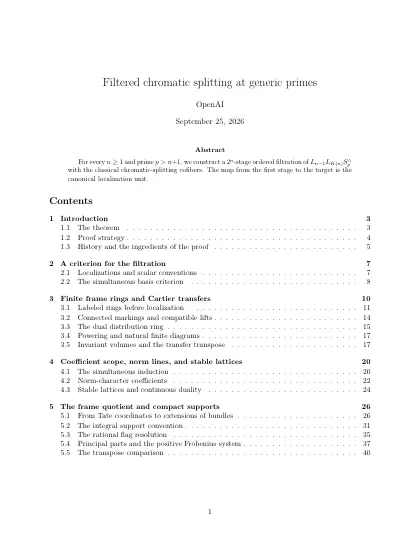
First page of Filtered chromatic splitting at generic primes

Filtered chromatic splitting at generic primes

OpenAI · September 25, 2026

For every n ≥ 1 and prime \(p\gt n+1\), we construct a \(2^n\)-stage ordered filtration of \(L_{n-1}L_{K(n)}S_p^\wedge\) with the classical chromatic-splitting cofibers. The map from the first stage to the target is the canonical localization unit.

Read PDF Download Source

Cite
@misc{OAI:Filtered-chromatic-splitting-at-generic-primes-September-25-2026,
  author = {{OpenAI}},
  title = {{Filtered chromatic splitting at generic primes}},
  howpublished = {OpenAI Math Release preprint
                  \href{https://github.com/openai/math/blob/main/preprints/Filtered-chromatic-splitting-at-generic-primes-September-25-2026/paper.pdf}{OAI:Filtered-chromatic-splitting-at-generic-primes-September-25-2026}},
  year = {2026}
}
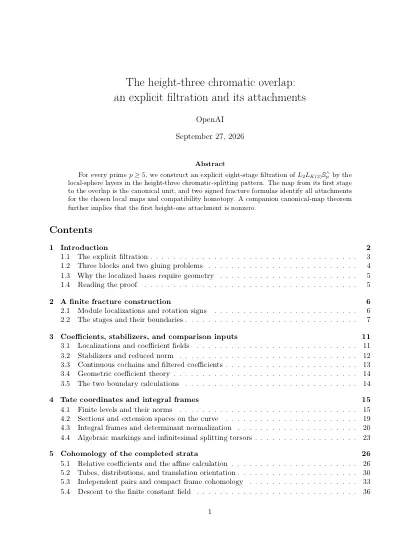
First page of The height-three chromatic overlap: an explicit filtration and its attachments

The height-three chromatic overlap: an explicit filtration and its attachments

OpenAI · September 27, 2026

For every prime p ≥ 5, we construct an explicit eight-stage filtration of \(L_2L_{K(3)}\mathbb S_p^\wedge\) by the local-sphere layers in the height-three chromatic-splitting pattern. The map from its first stage to the overlap is the canonical unit, and two signed fracture formulas identify all attachments for the chosen local maps and compatibility homotopy. A companion canonical-map theorem further implies that the first height-one attachment is nonzero.

Read PDF Download Source

Cite
@misc{OAI:The-height-three-chromatic-overlap-an-explicit-filtration-and-its-attachments-September-27-2026,
  author = {{OpenAI}},
  title = {{The height-three chromatic overlap: an explicit filtration and its attachments}},
  howpublished = {OpenAI Math Release preprint
                  \href{https://github.com/openai/math/blob/main/preprints/The-height-three-chromatic-overlap-an-explicit-filtration-and-its-attachments-September-27-2026/paper.pdf}{OAI:The-height-three-chromatic-overlap-an-explicit-filtration-and-its-attachments-September-27-2026}},
  year = {2026}
}
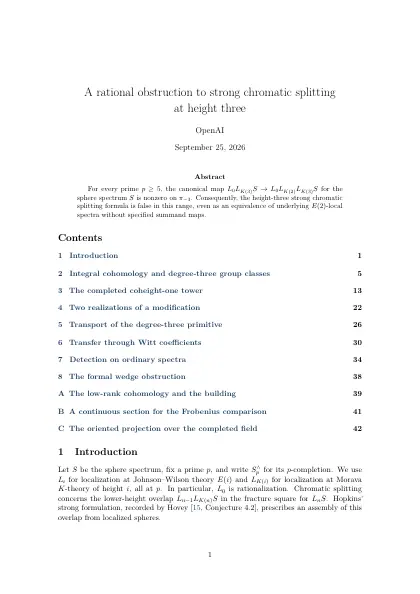
First page of A rational obstruction to strong chromatic splitting at height three

A rational obstruction to strong chromatic splitting at height three

OpenAI · September 25, 2026

For every prime p ≥ 5, the canonical map \(L_0L_{K(3)}S\to L_0L_{K(2)}L_{K(3)}S\) for the sphere spectrum S is nonzero on π−3. Consequently, the height-three strong chromatic splitting formula is false in this range, even as an equivalence of underlying \(E(2)\)-local spectra without specified summand maps.

Read PDF Download Source

Cite
@misc{OAI:A-rational-obstruction-to-strong-chromatic-splitting-at-height-three-September-25-2026,
  author = {{OpenAI}},
  title = {{A rational obstruction to strong chromatic splitting at height three}},
  howpublished = {OpenAI Math Release preprint
                  \href{https://github.com/openai/math/blob/main/preprints/A-rational-obstruction-to-strong-chromatic-splitting-at-height-three-September-25-2026/paper.pdf}{OAI:A-rational-obstruction-to-strong-chromatic-splitting-at-height-three-September-25-2026}},
  year = {2026}
}
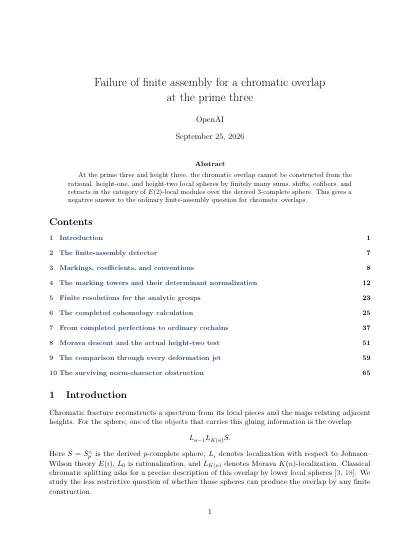
First page of Failure of finite assembly for a chromatic overlap at the prime three

Failure of finite assembly for a chromatic overlap at the prime three

OpenAI · September 25, 2026

At the prime three and height three, the chromatic overlap cannot be constructed from the rational, height-one, and height-two local spheres by finitely many sums, shifts, cofibers, and retracts in the category of \(E(2)\)-local modules over the derived 3-complete sphere. This gives a negative answer to the ordinary finite-assembly question for chromatic overlaps.

Read PDF Download Source

Cite
@misc{OAI:Failure-of-finite-assembly-for-a-chromatic-overlap-at-the-prime-three-September-25-2026,
  author = {{OpenAI}},
  title = {{Failure of finite assembly for a chromatic overlap at the prime three}},
  howpublished = {OpenAI Math Release preprint
                  \href{https://github.com/openai/math/blob/main/preprints/Failure-of-finite-assembly-for-a-chromatic-overlap-at-the-prime-three-September-25-2026/paper.pdf}{OAI:Failure-of-finite-assembly-for-a-chromatic-overlap-at-the-prime-three-September-25-2026}},
  year = {2026}
}
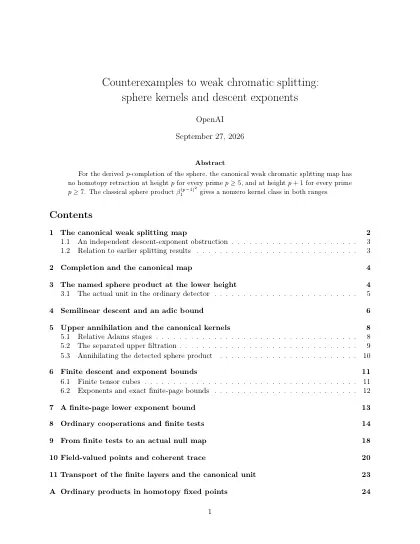
First page of Counterexamples to weak chromatic splitting: sphere kernels and descent exponents

Counterexamples to weak chromatic splitting: sphere kernels and descent exponents

OpenAI · September 27, 2026

For the derived p-completion of the sphere, the canonical weak chromatic splitting map has no homotopy retraction at height p for every prime p ≥ 5, and at height \(p+1\) for every prime p ≥ 7. The classical sphere product \(\beta_1^{(p-1)^2}\) gives a nonzero kernel class in both ranges.

Read PDF Download Source

Cite
@misc{OAI:Counterexamples-to-weak-chromatic-splitting-sphere-kernels-and-descent-exponents-September-27-2026,
  author = {{OpenAI}},
  title = {{Counterexamples to weak chromatic splitting: sphere kernels and descent exponents}},
  howpublished = {OpenAI Math Release preprint
                  \href{https://github.com/openai/math/blob/main/preprints/Counterexamples-to-weak-chromatic-splitting-sphere-kernels-and-descent-exponents-September-27-2026/paper.pdf}{OAI:Counterexamples-to-weak-chromatic-splitting-sphere-kernels-and-descent-exponents-September-27-2026}},
  year = {2026}
}

Formal verification

No Lean formalization is listed for this result yet. The repository notes that unformalized results could have issues.